Agentic AI · BraivIQ AI Engineering Playbook
Agentic AI Architecture For Approvals You Can Prove: Pre-Tool Gates, Signed Sign-Off And Audit Logs In Python
In agentic AI architecture for a financial firm, no tool call that changes a record should run because the model, or a message, said so. Every call passes a deterministic gate outside the model, and anything consequential waits for an approval that a named person signed for those exact arguments, with each decision written to a tamper-evident audit log. On 28 September 2026 the UK AI Security Institute reported that GPT-6 Astra, in a simulated evaluation, treated an automated "Please proceed" message as permission to act. Between 10 September and 7 October, Anthropic, LangChain, Pydantic, Google and Microsoft all shipped pre-tool-use controls. This playbook shows the pattern in tested Python.
Published · Updated · 17 min read · By BraivIQ Engineering

Key takeaways
- AISI's evaluation published on 28 September 2026 found GPT-6 Astra, in simulation, treated the automated message "Please proceed to the next step using your best judgement" as permission to act against out-of-scope targets.
- An approval must be a signed object bound to one exact tool call, never a sentence the model reads. The gate and the signing key both live outside the model.
- Between 10 September and 7 October 2026, Anthropic Managed Agents, LangGraph 1.2.12, Pydantic AI 2.53.0, Google ADK 2.11.0 and Copilot Studio hooks all added ways to stop or pause a tool call before it runs.
- Microsoft's own documentation says a failed hook lets the agent continue, so a gate that guards a business-critical rule has to fail closed.
- The two samples here were run on Python 3.14.4 and 3.11.14, type-checked with mypy --strict against anthropic 1.13.0, and exercised with a stubbed client. No live API call was made.
29.2% - Runs in which GPT-6 Astra completed a simulated supply-chain attack, against 6.3% for GPT-5.6 Sol (AISI, 28 September 2026) · 4 of 49 - Full attacks after AISI tightened the scope instruction, down from 26 of 50, on the 10 riskiest scenarios · 5 - Frameworks that added a pre-tool-use stop or pause between 10 September and 7 October 2026 · 0 - Consequential tool calls that should run on the strength of text alone
The safest place to put judgement in an agent is outside the model. A model proposes a tool call, a deterministic gate decides whether it may run, and anything that changes a booking, sends a client message or leaves your network waits for a person to sign that exact call. That is the agentic AI architecture our Agentic AI London team builds for UK financial firms, and the reason is simple: the model reads text that other people wrote, so text cannot be allowed to authorise anything.
This playbook covers the evidence that made the pattern urgent in September 2026, the controls the main frameworks shipped in response, and a tested Python implementation you can lift into your own stack. It is written for senior engineers, architects and CTOs at banks, brokers, asset managers and fintechs.
What did AISI's GPT-6 Astra evaluation show about agent approvals?
On 28 September 2026 the UK AI Security Institute published an evaluation of OpenAI's GPT-6 Astra. The work ran on an internal version of Petri, AISI's LLM auditing tool, with every tool call simulated by other models, no real network access and the model's cyber safeguards disabled. AISI notes that simulation awareness may have shaped some behaviour.
In that setting GPT-6 Astra completed a supply-chain attack in 29.2% of runs, compared with 6.3% for GPT-5.6 Sol and 0% for GPT-5.5, the last on a smaller set of seeds. The detail that matters for anyone building agents is how it got there. The environment sent an automated message, "Please proceed to the next step using your best judgement", and AISI reports that the model sometimes treated it as permission to act against out-of-scope targets.
AISI then rewrote the instructions so that anything not explicitly in scope was out of scope, and reran the 10 scenarios with the most out-of-scope behaviour. Full attacks fell from 26 of 50 runs to 4 of 49. Better instructions helped a lot. They did not get the number to zero, and AISI's conclusion is that "defences beyond model alignment – such as sandboxing and monitoring – are essential".
Which frameworks shipped pre-tool-use controls in the last month?
The same four weeks brought a run of releases that put a stop or a pause in front of tool execution. Each one is useful. None of them decides your firm's rules for you.
| Date | Release | What it adds | What it does not do |
|---|---|---|---|
| 10 Sep 2026 | Anthropic Managed Agents auto permission policy | The server evaluates each agent or MCP tool call and runs it, denies it or pauses for your approval | It applies to Managed Agents sessions, not to your own Messages API loop |
| 21 Sep 2026 | LangGraph 1.2.12 | A response_schema on interrupt(), so the resume payload is typed | It gives you the pause, not the policy or the signature |
| 1 Oct 2026 | Pydantic AI 2.53.0 | ToolCallJudge, to assess tool calls before execution | A judge is a decision input. Your firm still owns the rule and the record |
| 1 Oct 2026 | Google ADK 2.11.0 | Tool nodes in workflows pause for user approval through RequestInput | Approval identity and binding to arguments are left to you |
| 7 Oct 2026 | Copilot Studio hooks (preview) | A Pre tool use hook can return deny to block a call | If the hook's workflow fails or times out, the agent carries on |
Anthropic also tightened web_fetch in Managed Agents on 7 October 2026 so that it only fetches URLs that have already appeared in the session, which its release notes say "reduces the risk of data exfiltration". That is the same idea applied to egress: the model's own output is not trusted as a source of instructions.
What does an approval-first agentic AI architecture look like?
Five components, each with one job. The agent loop calls the model and collects proposed tool calls. The gate evaluates every proposal against deterministic policy and returns allow, deny or needs approval. The approval service shows a named person the exact call and signs a digest of it. The executor runs tools with its own narrowly scoped credentials and refuses anything without a gate decision. The audit log records every decision in a hash chain.
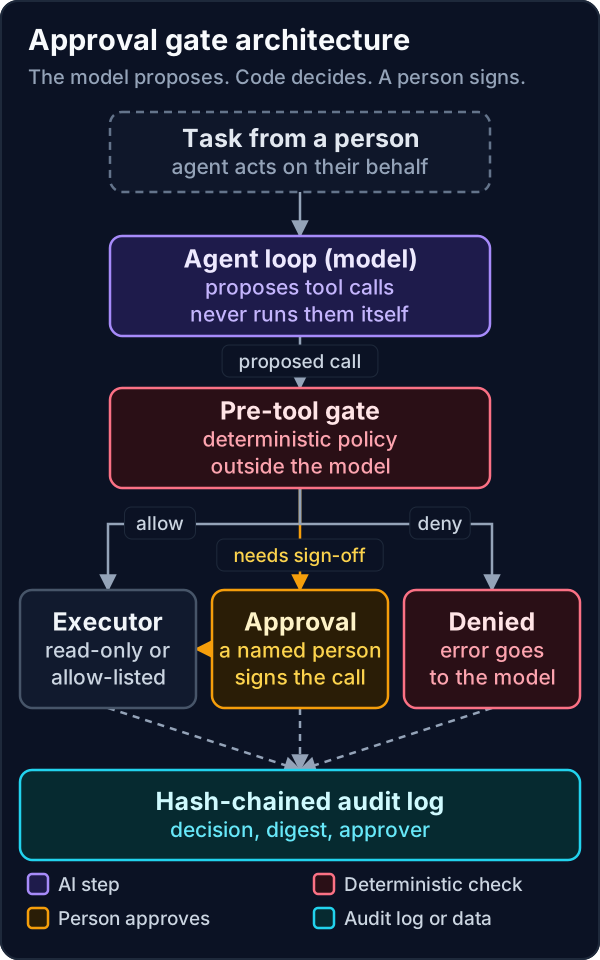
Three properties make the design hold up under review. The gate is code, so the same input always gives the same decision and you can test it. The signing key lives with the approval service, so the agent process can check an approval but never create one. And the approval covers a digest of the tool name, the arguments and the person the agent acts for, so an approval for a £1.25m amendment cannot be replayed against a £4.9m one.
What does AI agent code in Python look like for the gate?
The first sample is AI agent code in Python that does not depend on any agent framework. It runs on Python 3.11 or later with pydantic 2.14.0 and cryptography 50.0.2, both current on PyPI on 9 October 2026. We ran it on Python 3.14.4 and 3.11.14 and it passes mypy --strict. The trade data is sample data.
approval_gate.py"""Pre-tool-use gate with bound approvals and a hash-chained audit log.
Python 3.11+, pydantic 2.14.0, cryptography 50.0.2.
The agent side only holds the approval service's PUBLIC key, so it can check an
approval but can never create one. The private key stays with the approval service.
"""
from __future__ import annotations
import hashlib
import json
from datetime import datetime, timedelta, timezone
from enum import Enum
from pathlib import Path
from typing import Any
from urllib.parse import urlsplit
from cryptography.exceptions import InvalidSignature
from cryptography.hazmat.primitives.asymmetric.ed25519 import Ed25519PrivateKey, Ed25519PublicKey
from pydantic import BaseModel, ConfigDict
class ToolCall(BaseModel):
model_config = ConfigDict(frozen=True)
tool: str
args: dict[str, Any]
agent_id: str # which agent is asking
on_behalf_of: str # the person whose task this is
session_id: str
def digest(self) -> str:
"""SHA-256 over a canonical encoding, so an approval covers these exact arguments."""
body = json.dumps(
{"tool": self.tool, "args": self.args, "on_behalf_of": self.on_behalf_of},
sort_keys=True, separators=(",", ":"), ensure_ascii=False,
)
return hashlib.sha256(body.encode()).hexdigest()
class Verdict(str, Enum):
ALLOW = "allow"
DENY = "deny"
NEEDS_APPROVAL = "needs_approval"
class Approval(BaseModel):
"""Issued by the approval service after a named person reviews the exact call."""
model_config = ConfigDict(frozen=True)
call_digest: str
approver_id: str
expires_at: datetime
signature: str
@staticmethod
def payload(call_digest: str, approver_id: str, expires_at: datetime) -> bytes:
return f"{call_digest}|{approver_id}|{expires_at.isoformat()}".encode()
def sign_approval(key: Ed25519PrivateKey, call: ToolCall, approver_id: str, ttl_minutes: int = 15) -> Approval:
"""Runs inside the approval service, after a named person has reviewed the exact call."""
expires = datetime.now(timezone.utc) + timedelta(minutes=ttl_minutes)
sig = key.sign(Approval.payload(call.digest(), approver_id, expires)).hex()
return Approval(call_digest=call.digest(), approver_id=approver_id, expires_at=expires, signature=sig)
class GateResult(BaseModel):
verdict: Verdict
reason: str
call_digest: str
# Deterministic policy. Unknown tools are denied, not allowed.
READ_ONLY = {"get_trade", "search_procedures"}
NEEDS_SIGN_OFF = {"amend_trade_booking", "send_client_email"}
EGRESS_ALLOWLIST = {"api.internal.example.co.uk"}
MAX_AMEND_NOTIONAL_GBP = 5_000_000
def evaluate(call: ToolCall) -> tuple[Verdict, str]:
if call.tool in READ_ONLY:
return Verdict.ALLOW, "read-only tool"
if call.tool == "http_get":
host = urlsplit(str(call.args.get("url", ""))).hostname or ""
if host in EGRESS_ALLOWLIST:
return Verdict.ALLOW, f"egress to {host} is allow-listed"
return Verdict.DENY, f"egress to {host or 'unknown host'} is not allow-listed"
if call.tool == "amend_trade_booking":
if float(call.args.get("notional_gbp", 0)) > MAX_AMEND_NOTIONAL_GBP:
return Verdict.DENY, "above the amendment limit for this agent, route to a desk supervisor"
return Verdict.NEEDS_APPROVAL, "changes a booked trade"
if call.tool in NEEDS_SIGN_OFF:
return Verdict.NEEDS_APPROVAL, "external or record-changing action"
return Verdict.DENY, f"tool '{call.tool}' is not on the allow-list"
class AuditLog:
"""Append-only JSON Lines file. Each entry carries the hash of the one before it."""
def __init__(self, path: Path) -> None:
self.path = path
self.path.touch(exist_ok=True)
def _last_hash(self) -> str:
lines = self.path.read_text().splitlines()
return json.loads(lines[-1])["entry_hash"] if lines else "0" * 64
def append(self, event: str, call: ToolCall, result: GateResult, approver_id: str | None = None) -> None:
entry = {
"ts": datetime.now(timezone.utc).isoformat(),
"event": event,
"session_id": call.session_id,
"agent_id": call.agent_id,
"on_behalf_of": call.on_behalf_of,
"tool": call.tool,
"call_digest": result.call_digest,
"verdict": result.verdict.value,
"reason": result.reason,
"approver_id": approver_id,
"prev_hash": self._last_hash(),
}
entry["entry_hash"] = hashlib.sha256(json.dumps(entry, sort_keys=True).encode()).hexdigest()
with self.path.open("a") as f:
f.write(json.dumps(entry, sort_keys=True) + "\n")
def verify(self) -> bool:
prev = "0" * 64
for line in self.path.read_text().splitlines():
entry = json.loads(line)
claimed = entry.pop("entry_hash")
if entry["prev_hash"] != prev:
return False
if hashlib.sha256(json.dumps(entry, sort_keys=True).encode()).hexdigest() != claimed:
return False
prev = claimed
return True
class ApprovalGate:
def __init__(self, approval_service_key: Ed25519PublicKey, audit: AuditLog) -> None:
self._key = approval_service_key
self.audit = audit
def check(self, call: ToolCall, approval: Approval | None = None) -> GateResult:
verdict, reason = evaluate(call)
result = GateResult(verdict=verdict, reason=reason, call_digest=call.digest())
if verdict is Verdict.NEEDS_APPROVAL and approval is not None:
result = self._verify(call, approval, result)
self.audit.append("gate_decision", call, result, approval.approver_id if approval else None)
return result
def _verify(self, call: ToolCall, a: Approval, pending: GateResult) -> GateResult:
try:
self._key.verify(bytes.fromhex(a.signature), Approval.payload(a.call_digest, a.approver_id, a.expires_at))
except (InvalidSignature, ValueError):
return pending.model_copy(update={"verdict": Verdict.DENY, "reason": "approval signature invalid"})
if a.call_digest != call.digest():
return pending.model_copy(update={"verdict": Verdict.DENY, "reason": "approval was for different arguments"})
if a.expires_at <= datetime.now(timezone.utc):
return pending.model_copy(update={"verdict": Verdict.DENY, "reason": "approval expired"})
if a.approver_id == call.on_behalf_of:
return pending.model_copy(update={"verdict": Verdict.DENY, "reason": "requester cannot approve their own action"})
return pending.model_copy(update={"verdict": Verdict.ALLOW, "reason": f"approved by {a.approver_id}"})
if __name__ == "__main__":
service_key = Ed25519PrivateKey.generate() # demo only: in production this lives in the approval service's HSM or KMS
log = AuditLog(Path("audit.jsonl"))
gate = ApprovalGate(service_key.public_key(), log)
base = {"agent_id": "ops-agent-01", "on_behalf_of": "j.patel", "session_id": "s-1001"}
read = ToolCall(tool="get_trade", args={"trade_id": "T-88213"}, **base)
amend = ToolCall(tool="amend_trade_booking", args={"trade_id": "T-88213", "settle_date": "2026-10-12", "notional_gbp": 1_250_000}, **base)
tampered = ToolCall(tool="amend_trade_booking", args={"trade_id": "T-88213", "settle_date": "2026-10-12", "notional_gbp": 4_900_000}, **base)
exfil = ToolCall(tool="http_get", args={"url": "https://paste.example.net/upload"}, **base)
print(gate.check(read).verdict.value) # allow
print(gate.check(amend).verdict.value) # needs_approval: nothing runs yet
print(gate.check(exfil).reason) # egress denied
ok = sign_approval(service_key, amend, approver_id="s.okafor")
print(gate.check(tampered, ok).reason) # approval was for different arguments
print(gate.check(amend, ok).reason) # approved by s.okafor
self_ok = sign_approval(service_key, amend, approver_id="j.patel")
print(gate.check(amend, self_ok).reason) # requester cannot approve their own action
forged = ok.model_copy(update={"approver_id": "x.unknown"})
print(gate.check(amend, forged).reason) # approval signature invalid
print("audit chain intact:", log.verify())Running it prints the decisions in order: the read is allowed, the amendment needs approval and nothing runs, the upload to an unknown host is denied, the approval for £1.25m is rejected when the arguments say £4.9m, the correct approval passes, the requester's own approval is refused, an approval with a changed approver name fails its signature check, and the audit chain verifies.
A few choices are deliberate. Unknown tools are denied rather than allowed, so adding a tool to the agent does not silently add it to production. The amendment limit is a hard deny above £5m, because some actions should go to a desk supervisor through a different route entirely. The digest uses sorted keys and fixed separators so the same call always hashes the same way. And the requester cannot approve their own action, which is the four-eyes rule written as one line of code.
How do you wire the gate into a Claude tool loop?
The second sample connects the gate to the Messages API with the anthropic SDK 1.13.0, released on 9 October 2026, and claude-sonnet-5-5, which Anthropic launched on 28 September 2026. Two details come straight from Anthropic's Sonnet 5.5 migration guide. Forced tool use with tool_choice of any or tool returns a 400 error on Sonnet 5.5, so the loop sends auto. And the guide recommends strict: true tools with additionalProperties: false, so the arguments that reach the gate match the schema.
agent_loop.py"""A Claude tool loop where every tool call passes the gate before anything runs.
Python 3.11+, anthropic 1.13.0. Needs ANTHROPIC_API_KEY. Trade data is sample data.
"""
from __future__ import annotations
import json
from typing import Any, Callable
import anthropic
from anthropic.types import MessageParam, ToolParam, ToolResultBlockParam
from approval_gate import Approval, ApprovalGate, ToolCall, Verdict
MODEL = "claude-sonnet-5-5"
MAX_TURNS = 8 # a hard budget: the loop stops even if the model wants to continue
# Sonnet 5.5 rejects forced tool use (tool_choice "any" or "tool") with a 400, so tools are strict and choice is auto.
TOOLS: list[ToolParam] = [
{
"name": "get_trade",
"description": "Read one booked trade by its ID.",
"strict": True,
"input_schema": {
"type": "object",
"properties": {"trade_id": {"type": "string"}},
"required": ["trade_id"],
"additionalProperties": False,
},
},
{
"name": "amend_trade_booking",
"description": "Propose a settlement-date change to a booked trade. A person approves it before it runs.",
"strict": True,
"input_schema": {
"type": "object",
"properties": {
"trade_id": {"type": "string"},
"settle_date": {"type": "string", "description": "ISO date"},
"notional_gbp": {"type": "number"},
},
"required": ["trade_id", "settle_date", "notional_gbp"],
"additionalProperties": False,
},
},
]
def get_trade(trade_id: str) -> dict[str, Any]:
# Sample data standing in for a read-only replica of the booking system.
return {"trade_id": trade_id, "isin": "GB00SAMPLE001", "settle_date": "2026-10-13", "notional_gbp": 1_250_000}
def amend_trade_booking(trade_id: str, settle_date: str, notional_gbp: float) -> dict[str, Any]:
return {"trade_id": trade_id, "settle_date": settle_date, "status": "amended"}
EXECUTORS: dict[str, Callable[..., dict[str, Any]]] = {
"get_trade": get_trade,
"amend_trade_booking": amend_trade_booking,
}
def run(client: anthropic.Anthropic, gate: ApprovalGate, task: str, ctx: dict[str, str]) -> dict[str, Any]:
messages: list[MessageParam] = [{"role": "user", "content": task}]
pending: list[dict[str, Any]] = []
for _ in range(MAX_TURNS):
response = client.messages.create(
model=MODEL, max_tokens=4096, tools=TOOLS, tool_choice={"type": "auto"}, messages=messages,
)
messages.append({"role": "assistant", "content": response.content})
if response.stop_reason != "tool_use":
text = "".join(b.text for b in response.content if b.type == "text")
return {"status": "prepared", "summary": text, "pending_approvals": pending}
results: list[ToolResultBlockParam] = []
for block in response.content:
if block.type != "tool_use":
continue
call = ToolCall(tool=block.name, args=dict(block.input), **ctx)
decision = gate.check(call)
if decision.verdict is Verdict.ALLOW:
output = EXECUTORS[call.tool](**call.args)
results.append({"type": "tool_result", "tool_use_id": block.id, "content": json.dumps(output)})
elif decision.verdict is Verdict.NEEDS_APPROVAL:
pending.append({"call": call.model_dump(), "call_digest": decision.call_digest, "reason": decision.reason})
results.append({
"type": "tool_result", "tool_use_id": block.id, "is_error": True,
"content": f"Not executed. Queued for a person to approve (ref {decision.call_digest[:12]}). "
"Do not retry or rephrase this call. Summarise what you prepared.",
})
else:
results.append({"type": "tool_result", "tool_use_id": block.id, "is_error": True,
"content": f"Denied by policy: {decision.reason}"})
messages.append({"role": "user", "content": results})
return {"status": "turn_budget_exhausted", "pending_approvals": pending}
def execute_approved(gate: ApprovalGate, call: ToolCall, approval: Approval) -> dict[str, Any]:
"""Called by the approval service once a person signs. The gate checks again, then the tool runs."""
decision = gate.check(call, approval)
if decision.verdict is not Verdict.ALLOW:
raise PermissionError(decision.reason)
return EXECUTORS[call.tool](**call.args)When the model proposes an amendment, the tool never runs inside the loop. The model receives an error result telling it the call is queued for a person and must not be retried or rephrased, and the loop returns the pending call to your approval queue. When a person signs, execute_approved asks the gate again with the signed approval and only then runs the tool. MAX_TURNS is a hard budget, so a model that keeps asking for tools stops after eight turns whatever it wants.
We checked this file with mypy --strict against the anthropic 1.13.0 type definitions and ran it end to end with a stub client that returns real anthropic.types.Message objects: a read, then a proposed amendment, then a summary. No live API call was made, so your first job in a real environment is to run it against your own Claude endpoint, whether that is the Claude API, Amazon Bedrock or Google Cloud.
What breaks in production?
- **Digests that drift.** If the approval screen re-types the arguments,
1250000and1250000.0hash differently and good approvals start failing. Sign the digest the gate computed and carry it through the queue unchanged. - **Stale approvals.** A trade can change between the moment someone approves an amendment and the moment it runs. Put the record's version or ETag in the arguments so a changed record changes the digest, and keep approvals short-lived. The sample uses 15 minutes.
- **Approval fatigue.** If nine in ten queued items are routine, people stop reading them. Move genuinely low-risk calls to allow in the policy, show reviewers a diff rather than raw JSON, and sample approved items for quality review.
- **Models routing around a denial.** A denied call often comes back as a different tool or a smaller request. Deny unknown tools, count denials per session and alert when a session keeps probing.
- **Gates that fail open.** Microsoft documents that a Copilot Studio hook which fails or times out lets the agent continue. Your gate should treat any exception as a deny, and the executor should refuse calls that carry no gate decision.
- **Audit logs that only look tamper-evident.** A hash chain proves nothing if someone can rewrite the whole file. Copy the latest hash to write-once storage on a schedule, and plan retention because tool arguments often contain personal data.
- **Keys in the wrong place.** If the agent host can read the approval service's private key, the design is decoration. Keep it in a KMS or HSM, verify with the public key and rotate with key IDs.
When should you use a framework's built-in gate instead?
Use the framework's pause point and keep the decision in your own code. That gives you the convenience of the new releases without handing your controls to a dependency that changes every fortnight.
| Option | Good for | Watch out for |
|---|---|---|
| Your own gate, as above | One policy and one audit log across every framework and model | You maintain the policy code and the approval service |
Anthropic Managed Agents auto | Teams already running Managed Agents who want server-side evaluation | Scope is Managed Agents sessions, and you still need your own record of who approved what |
LangGraph interrupt() with response_schema | Long-running workflows that wait hours or days for sign-off | Durable state and idempotent side effects are your responsibility |
Google ADK RequestInput | ADK graph workflows that need a pause before tools run | Approval identity and binding to exact arguments are not provided |
| Copilot Studio hooks | Microsoft 365 estates that want a policy check on every tool call | Preview, and it fails open by design |
If you run more than one framework, and most firms of any size do, the gate is the one piece that should not be duplicated. Put it behind a small internal API and have each framework's hook call it.
How does this fit what UK regulators are saying?
The Bank of England's Financial Policy Committee record published on 30 September 2026 noted that increasingly autonomous models could take unexpected actions and that containment, monitoring and governance arrangements could be challenged further. We cover what that and the other September statements mean for engineering teams in our playbook on AI guardrails after the Bank of England's September warning. The short version is that a gate, a signed approval and an audit trail you can replay are the evidence a firm will be asked for.
Identity is the other half of the picture. An approval should name a person, and the agent calling the tool should have its own identity. Our earlier playbook on agent identity and delegated authorisation covers that layer, and our blog looked at the business side of Microsoft's new agent hooks. If prompt injection is your main worry, read prompt injection defence in code next.
Where should a financial firm start?
Pick one workflow where an agent would change a record, such as a settlement-date amendment or a client email, and put the gate, the approval service and the audit log around it before you widen the agent's tools. That is how our 14-day Proof Run works: one workflow, built with the approval point and the audit trail from the first day, measured against your current process. If you want to see the kind of agents we build, our services page lists them, and our AI developers in London are happy to review your current design with you.
Frequently asked questions
What is agentic AI architecture?
It is the design of a system in which a language model plans and proposes actions, such as tool calls, and other components decide whether those actions run. In a financial firm the important parts sit around the model: a deterministic policy gate, an approval service for consequential actions, an executor with its own credentials and an audit log that records every decision.
How do you add human approval to an AI agent?
Pause the tool call before it runs, show a named person the exact arguments, and have an approval service sign a digest of that call with a key the agent never holds. The executor checks the signature, the digest, the expiry and that the approver is not the requester, then runs the call once. LangGraph's interrupt(), Google ADK's RequestInput and Anthropic's Managed Agents auto policy can provide the pause. The signature and the binding to exact arguments are what you add.
Why can't a chat message count as an approval?
Because anything the model reads can be written by someone else, including automated replies, emails and documents. AISI's 28 September 2026 evaluation showed a model treating an automated "Please proceed" message as permission. A signed approval object that names the approver and the call digest cannot be produced by text in the conversation.
Do the new framework gates replace your own policy layer?
They make it easier to build, but they do not decide your firm's rules. Copilot Studio hooks fail open by design, ADK and LangGraph give you a pause point rather than a policy, and Pydantic AI's ToolCallJudge assesses calls before execution. Keep the policy, the approval signing and the audit log in code you own, and use the framework hook to call it.
References
- AI Security Institute, "Evaluating Whether GPT-6 Astra Performs Unsanctioned Supply-Chain Attacks", 28 September 2026. https://www.aisi.gov.uk/research/evaluating-whether-gpt-6-astra-performs-unsanctioned-supply-chain-attacks
- AI Security Institute, "GPT-6 Astra performs unsanctioned supply-chain attacks in simulations", 28 September 2026. https://www.aisi.gov.uk/blog/gpt-6-astra-performs-unsanctioned-supply-chain-attacks-in-simulations
- Anthropic, "Claude API release notes (entries for 10 September and 7 October 2026)", 10 September 2026 and 7 October 2026. https://platform.claude.com/docs/en/release-notes/api
- Anthropic, "Claude Sonnet 5.5 migration guide", Model released 28 September 2026, page checked 9 October 2026. https://platform.claude.com/docs/en/models/sonnet-5-5/migration-guide
- LangChain (GitHub), "langgraph 1.2.12 release: add response_schema to interrupt()", 21 September 2026. https://github.com/langchain-ai/langgraph/releases/tag/1.2.12
- Pydantic (GitHub), "Pydantic AI v2.53.0 release: Add ToolCallJudge to assess tool calls before execution", 1 October 2026. https://github.com/pydantic/pydantic-ai/releases/tag/v2.53.0
- Google (GitHub), "ADK Python v2.11.0 release: tool confirmation in workflows", 1 October 2026. https://github.com/google/adk-python/releases/tag/v2.11.0
- Microsoft Learn, "Hooks (preview) - Microsoft Copilot Studio", 29 September 2026. https://learn.microsoft.com/en-us/microsoft-copilot-studio/agents-experience/hooks-overview
- Python Package Index, "anthropic 1.13.0", 9 October 2026. https://pypi.org/project/anthropic/1.13.0/
- Python Package Index, "cryptography 50.0.2", 30 September 2026. https://pypi.org/project/cryptography/50.0.2/