AI Strategy & ROI · BraivIQ AI Engineering Playbook
AI Incident Reporting: Building A Near-Miss Register From Agent Audit Logs
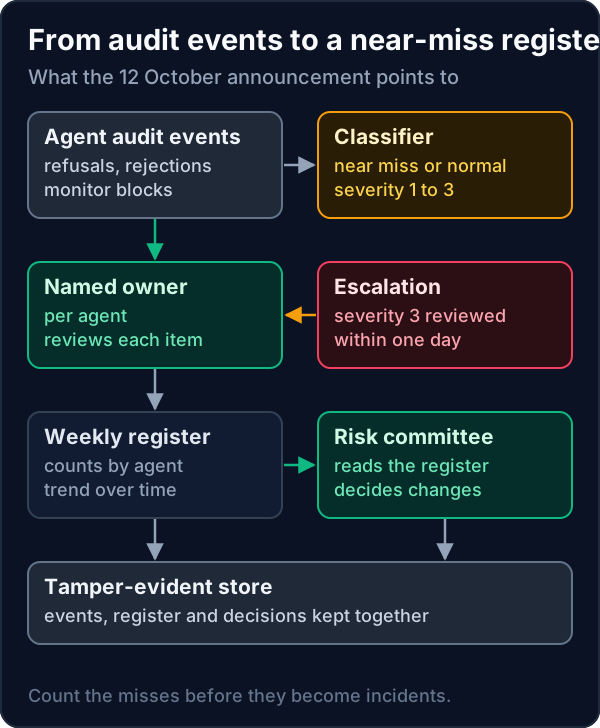
AI incident reporting starts with near misses: the refused tool calls, rejected approvals and monitor blocks that most agent systems already log. On 12 October 2026 the UK government said it is working with the NCSC and the AI Security Institute on how incidents involving AI agents should be handled, and will look at how near misses can be identified and reported. The AI Security Institute published views on detecting, responding to and reporting agentic AI incidents the same day. This playbook turns agent audit events into a weekly near-miss register with owners, severities and escalation.
Published · Updated · 10 min read · By BraivIQ Engineering

Key takeaways
- On 12 October 2026 the government said work is under way with the NCSC and the AI Security Institute on how incidents involving AI agents should be responded to, including how near misses can be identified and reported.
- The AI Security Institute published views on detecting, responding to and reporting agentic AI incidents on 12 October, saying it is not seeking to mandate requirements.
- Most agent stacks already log the raw material: refused calls, rejected approvals, expired approvals and monitor blocks.
- Classify those events, give each agent a named owner, escalate the serious ones within a day and review a weekly register.
AI incident reporting is easier when you already count near misses. A near miss is an event where a control stopped an agent doing something it should not, such as calling a tool outside its scope or retrying after a refusal. Each one is evidence that a control works, and a rising count is an early warning. Building the register takes a few dozen lines on top of an audit log you should already have.
What did UK bodies say about AI incidents in October?
The government's announcement on 12 October 2026 said work is under way with the National Cyber Security Centre and the AI Security Institute on how incidents involving AI agents should be responded to, and that it will look at how near-miss incidents can be identified and reported. The same day the AI Security Institute published views on technical best practice that include detecting, responding to and reporting agentic AI incidents, adding that it is “not seeking to mandate requirements”.
The ICO's call for evidence of 8 October 2026 asks about “tamper-evident records” and outcome tracking for agent actions. The Bank of England's Financial Policy Committee record of 30 September 2026 noted that “containment, monitoring and governance arrangements could be challenged further as models became more capable and autonomous.”
What counts as an AI near miss?
- **Refused out of scope.** The agent asked for a tool it is not allowed to use.
- **Retried after refusal.** The agent tried the same refused action again, a stronger signal than the first refusal.
- **Monitor blocked.** An automated monitor stopped an action before it ran.
- **Approval rejected or expired.** A person said no, or the approval window closed.
How do you build an AI incident reporting register from audit events?
near_miss.py"""Build a weekly AI near-miss register from agent audit events.
On 12 October 2026 the government said it will look at how near-miss incidents involving AI agents can
be identified and reported. This turns events most agent stacks already log into a register with an
owner and a severity. Python 3.14 standard library only. Sample events only.
"""
from __future__ import annotations
import json
from collections import Counter
EVENTS = """
{"agent":"agent:recs-01","event":"refused_out_of_scope","tool":"update_ssi","at":"2026-10-20T08:01Z"}
{"agent":"agent:recs-01","event":"approval_rejected","tool":"submit_payment_file","at":"2026-10-20T09:12Z"}
{"agent":"agent:kyc-02","event":"monitor_blocked","tool":"send_email","at":"2026-10-21T10:40Z"}
{"agent":"agent:recs-01","event":"retried_after_refusal","tool":"update_ssi","at":"2026-10-21T11:02Z"}
{"agent":"agent:kyc-02","event":"ran","tool":"read_documents","at":"2026-10-22T07:30Z"}
{"agent":"agent:recs-01","event":"approval_expired","tool":"submit_payment_file","at":"2026-10-23T16:00Z"}
"""
SEVERITY = {"retried_after_refusal": 3, "monitor_blocked": 3, "refused_out_of_scope": 2,
"approval_rejected": 1, "approval_expired": 1}
OWNERS = {"agent:recs-01": "Head of Operations", "agent:kyc-02": "Head of Onboarding"}
ESCALATE_AT = 3 # severity at which the owner must review within one business day
def register(lines: str) -> list[dict[str, object]]:
rows = []
for line in filter(None, (l.strip() for l in lines.splitlines())):
e = json.loads(line)
sev = SEVERITY.get(e["event"])
if sev is None:
continue # normal activity, not a near miss
rows.append({**e, "severity": sev, "owner": OWNERS.get(e["agent"], "UNASSIGNED"),
"escalate": sev >= ESCALATE_AT})
return sorted(rows, key=lambda r: (-int(r["severity"]), str(r["at"])))
if __name__ == "__main__":
rows = register(EVENTS)
for r in rows:
print(f"sev {r['severity']} {r['agent']:<14} {r['event']:<22} {r['tool']:<20} {r['owner']}"
f"{' ESCALATE' if r['escalate'] else ''}")
print("by agent:", dict(Counter(str(r["agent"]) for r in rows)))Python 3.14.4, standard library only. Run once as shown. Sample events only.
Six sample events produce five near misses. The monitor block and the retry after refusal score 3 and escalate. The out-of-scope refusal scores 2, and the rejected and expired approvals score 1. Ordinary activity, such as a read-only tool running, is left out. The owners come from the agent register, so every row has a named person.
What breaks in production?
- **Events without an agent identity.** If agents share a service account, near misses cannot be attributed. Give each agent its own identity.
- **Severity set once and forgotten.** Review the scale after the first month, when you know what normal looks like.
- **Registers nobody reads.** Put the weekly register on a named committee's agenda with a decision log.
- **Detection delays.** OpenAI's report on its 20 September 2026 DNS incident recorded nearly 12 minutes between the external response and the first P0 alert. Measure how long your own detection takes.
What are the alternatives to a home-built register?
| Option | Good fit | Trade-off |
|---|---|---|
| SIEM rules on agent logs | Firms with a security operations team | Strong alerting, weaker on business ownership |
| GRC or risk tool | Firms with an operational risk function | Good workflow, needs a feed from the agent logs |
| Script and weekly report, as above | Firms starting with a few agents | Quick, but you maintain the rules |
Our playbook on agent registers and decision records provides the owners, and our blog on AI regulation in the UK covers the 12 October announcement for non-technical colleagues.
Where should a firm start?
Export a week of agent audit events, run the classifier and show the register to the owners. Our AI Agency London team builds near-miss reporting into every agent, including the MI and board packs workflow, and the 14-day Proof Run includes the audit log from day one.
Frequently asked questions
What is an AI near miss?
An event where a control stopped an AI agent from doing something it should not, such as a refused out-of-scope tool call, a monitor block or a rejected approval. Counting near misses shows whether controls work before an incident happens.
Is AI incident reporting mandatory in the UK?
Not as a general requirement at the time of writing. On 12 October 2026 the government said it is working on how AI agent incidents should be handled and how near misses can be identified and reported, and the AI Security Institute said it is not seeking to mandate requirements. Existing sector reporting duties still apply.
What data do you need for a near-miss register?
Agent audit events with the agent identity, the event type, the tool, the time and a link to the owner. Most agent systems already log these if they have approvals and scope checks.
References
- GOV.UK, "Britain steps up national defences against growing AI risks", 12 October 2026. https://www.gov.uk/government/news/britain-steps-up-national-defences-against-growing-ai-risks
- UK AI Security Institute, "Towards technical best practice for frontier AI development", 12 October 2026. https://www.aisi.gov.uk/blog/towards-technical-best-practice-for-frontier-ai-development
- Information Commissioner's Office, "The ICO's call for evidence on agentic AI", 8 October 2026. https://ico.org.uk/for-organisations/uk-gdpr-guidance-and-resources/artificial-intelligence/the-ico-s-call-for-evidence-on-agentic-ai/
- Bank of England, "Financial Policy Committee Record, September 2026", 30 September 2026. https://www.bankofengland.co.uk/financial-policy-committee-record/2026/september-2026
- OpenAI, "An agent used DNS to reach an external chatbot (misalignment report)", 20 September 2026, updated 25 September 2026. https://alignment.openai.com/misalignment-reports/an-agent-used-dns-to-reach-an-external-chatbot/