AI Integration · BraivIQ AI Engineering Playbook
Calibrated LLM Decisions: Testing Confidence Scores Before You Let Them Route Work
Calibrated LLM decisions are model outputs whose confidence matches how often they are right. On 11 November 2026 Google released Gemini Decision (gemini-decision-1) and the Decisions API for fast, calibrated binary, categorical and rubric decisions across text, images, audio, video and PDFs with zero output tokens. A provider's calibration is a starting point, not evidence for your data. This guide shows how to measure calibration on your own reviewed decisions, set a threshold for automatic routing and send the rest to a person, with tested Python.
Published · Updated · 7 min read · By BraivIQ Engineering

Key takeaways
- Google released Gemini Decision (gemini-decision-1) and the Decisions API on 11 November 2026, according to the Gemini API changelog.
- The changelog describes fast, calibrated binary, categorical and rubric decisions across text, images, audio, video and PDFs, with zero output tokens.
- Calibration means a confidence of 0.9 is right about 90% of the time. Check it on your own labelled decisions before trusting it.
- Set a threshold from a reviewed sample so automatic routing meets an agreed accuracy, and send everything below it to a person.
- Recheck calibration on a schedule and log the score, threshold and reviewer for every decision.
Calibrated LLM decisions are classifications where the confidence score means what it says. If a model labels a thousand alerts at 0.9 confidence, about nine hundred should be right. That property is what lets you route the confident cases automatically and send the rest to a person. On 11 November 2026 Google released a model and an API built around it.
What did Google release on 11 November?
The Gemini API changelog for 11 November 2026 announces Gemini Decision (gemini-decision-1) and the Decisions API. It describes them as fast, calibrated binary, categorical and rubric decisions across text, images, audio, video and PDFs, with zero output tokens. Pricing and rate limits are published on the Gemini API site.
Zero output tokens means the API returns a decision rather than generated text, which changes the cost and speed profile compared with prompting a general model to answer in a fixed format. Our playbook on LLM classification and decision models covers the general approach and when a decision model suits a task.
What do calibrated LLM decisions mean in practice?
Calibration is about the link between confidence and accuracy, not accuracy alone. A model can be accurate but overconfident, giving 0.99 on cases it gets wrong. It can also be underconfident, giving 0.7 on cases it nearly always gets right. Either way, a threshold set on the raw score routes the wrong cases.
Provider calibration is measured on the provider's data. Your alerts, documents and categories are different. The only evidence that counts for your workflow is a sample of your own decisions, labelled by your reviewers.
| Term | What it means | What to check |
|---|---|---|
| Reliability | Accuracy in each confidence band | Each band's accuracy close to its mean confidence |
| Expected calibration error | Average gap between confidence and accuracy, weighted by volume | Lower is better, track it over time |
| Coverage | Share of cases above the threshold | Enough volume to be worth automating |
| Agreed accuracy | Accuracy the business signs off for automatic routing | Set by the process owner, not the engineer |
How do you measure calibration on your own data?
Take a few thousand past decisions that a person reviewed, with the model confidence for each. Group them into confidence bands, compare each band's mean confidence with its accuracy, and compute the weighted gap. Then search for the lowest threshold at which the cases above it meet the agreed accuracy.
calibration.py"""Check whether model confidence can be trusted, then set a review threshold.
Python 3.14, standard library only. The labelled sample is generated, replace it
with your own reviewed decisions before relying on the threshold."""
import random
rng = random.Random(7)
SAMPLE = [] # (confidence the model gave, whether a reviewer agreed)
for _ in range(2000):
conf = rng.betavariate(5, 1.6)
SAMPLE.append((conf, rng.random() < conf ** 0.5))
def reliability(sample, bins=10):
rows, ece = [], 0.0
for b in range(bins):
lo, hi = b / bins, (b + 1) / bins
part = [(c, ok) for c, ok in sample if lo <= c < hi or (b == bins - 1 and c == 1.0)]
if not part:
continue
conf = sum(c for c, _ in part) / len(part)
acc = sum(ok for _, ok in part) / len(part)
ece += len(part) / len(sample) * abs(conf - acc)
rows.append((f"{lo:.1f}-{hi:.1f}", len(part), round(conf, 3), round(acc, 3)))
return rows, ece
def pick_threshold(sample, target_acc=0.97, min_cover=0.15):
for t in [x / 100 for x in range(50, 100)]:
auto = [ok for c, ok in sample if c >= t]
if len(auto) / len(sample) < min_cover:
break
if auto and sum(auto) / len(auto) >= target_acc:
return t, len(auto) / len(sample), sum(auto) / len(auto)
return None, 0.0, 0.0
if __name__ == "__main__":
rows, ece = reliability(SAMPLE)
print("bin n mean conf accuracy")
for r in rows:
print(f"{r[0]:8} {r[1]:5} {r[2]:9} {r[3]:8}")
print(f"expected calibration error {ece:.3f}")
t, cover, acc = pick_threshold(SAMPLE)
if t is None:
print("no safe threshold: send every decision to a person")
else:
print(f"auto-route at >= {t:.2f}: {cover:.0%} of cases, {acc:.1%} agreed, the rest go to a person")Python 3.14, standard library only. The sample is generated, so replace it with your own reviewed decisions. Run once, it shows a model that is underconfident in every band, an expected calibration error of 0.111 and a threshold of 0.91 that routes 16% of cases automatically at 97.9% agreement.
The output illustrates a common result. The scores were usable for ranking but not as probabilities, since accuracy ran ahead of confidence in each band. The threshold still works because it is chosen from observed agreement, not from the score's face value. With 84% of cases still going to a person, the gain is real but modest, which is often the honest answer in a first release.
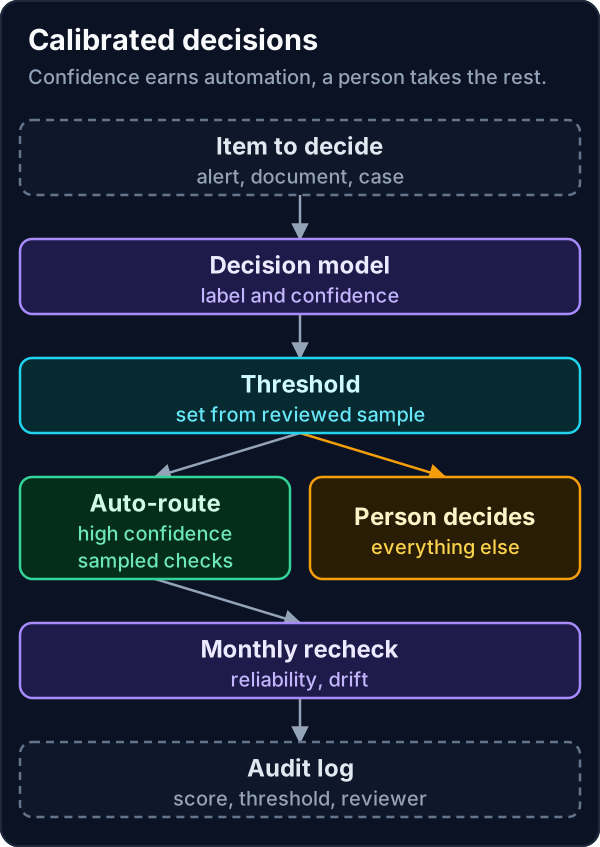
Where does the person sit?
Below the threshold, a person decides every case. Above it, the decision routes automatically but a sample still goes to review, so you notice drift. The process owner, not the engineer, signs off the agreed accuracy and the threshold. Both go in the audit log with the date and the sample size behind them.
For decisions that affect clients, such as onboarding outcomes, keep a person on every case and use the score only to order the queue. Our human-in-the-loop explainer explains the options in plain English.
What breaks in production?
- **Drift.** New products or new fraud patterns change the mix and the threshold stops holding. Recheck monthly and after any change upstream.
- **Small bands.** A band with a dozen cases tells you little. Require a minimum count before trusting it.
- **Model changes.** A new model version needs a fresh calibration run. Pin the model and treat a change as a release.
- **Label quality.** Calibration measured against rushed reviews inherits their errors. Spot-check the labels.
- **Rare classes.** A category that appears once a month hides inside the overall numbers. Measure it separately.
What are the trade-offs and alternatives?
A dedicated decision API is fast and cheap per call but ties you to one provider's categories and format. Prompting a general model for a label and a confidence is flexible, but its stated confidence is often poorly calibrated. A small classifier trained on your own labelled history can be the best calibrated of all, at the cost of maintaining it.
Whichever you use, calibration on your data is the deciding test. As a Workflow Automation Agency we run the comparison on a client's past decisions before choosing.
Where should a team start?
Export a few thousand reviewed decisions with their outcomes, run the calibration check and agree an accuracy level with the process owner. Our article on synthetic data testing covers safe ways to begin before real data is involved. AI Automation London clients often start with client onboarding files triage, and a 14-day Proof Run can measure calibration on your own history. This guide is engineering guidance, not legal or regulatory advice.
Frequently asked questions
What is the Gemini Decisions API?
Released on 11 November 2026 with the gemini-decision-1 model, it provides calibrated binary, categorical and rubric decisions across text, images, audio, video and PDFs with zero output tokens, according to the Gemini API changelog.
What does a calibrated confidence score mean?
That the score matches how often the model is right. Across many decisions at 0.9 confidence, about 90% should be correct.
How do I set a threshold for automatic routing?
Use a sample of decisions your reviewers labelled, find the lowest threshold where cases above it meet the accuracy the process owner agreed, and send everything below it to a person.
How often should calibration be checked?
At least monthly, and after any change to the model, the input data or the categories.
References
- Google, "Gemini API changelog", 2 to 11 November 2026. https://ai.google.dev/gemini-api/docs/changelog