RAG & LLM Engineering · BraivIQ AI Engineering Playbook
LLM Observability Security: What The 27 October MLflow Advisories Mean For Your Tracking Server
LLM observability security matters because traces and evaluation servers hold prompts, outputs and sometimes keys. On 27 October 2026 MLflow published three advisories fixed in 3.17.0: remote code execution on unauthenticated servers through third-party scorers (CVE-2026-116692, CVSS 9.8), arbitrary file read on unauthenticated servers (CVE-2026-116690) and CrewAI autologging that wrote LLM provider API keys into trace spans (CVE-2026-116691). This playbook audits a tracking server deployment and redacts secrets from trace attributes, in tested Python.
Published · Updated · 9 min read · By BraivIQ Engineering

Key takeaways
- MLflow 3.17.0 fixes CVE-2026-116692 (CVSS 9.8, remote code execution via third-party scorers on unauthenticated servers), published on 27 October 2026.
- It also fixes CVE-2026-116690 (CVSS 7.5, arbitrary file read on unauthenticated servers) and CVE-2026-116691 (CrewAI autologging writing LLM provider API keys into traces).
- The advisories note that running without authentication is the default for mlflow server.
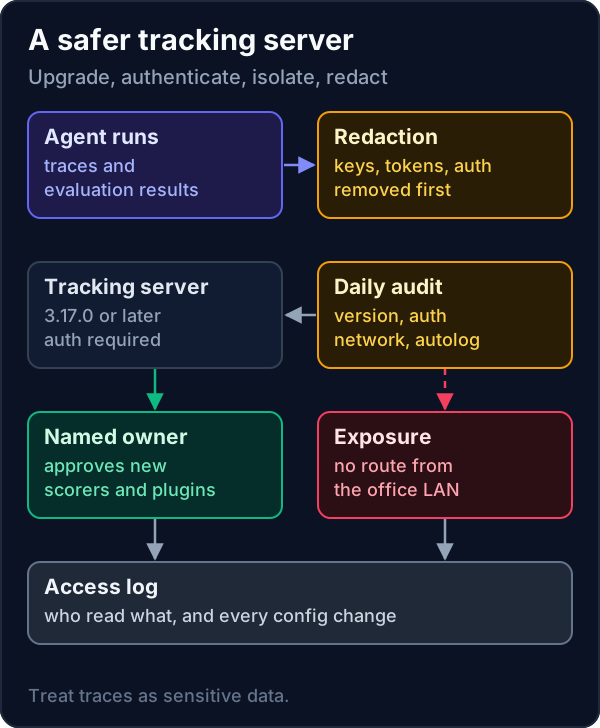
- Upgrade, require authentication, keep the server on the evaluation network and redact trace attributes before export.
LLM observability security means treating traces, evaluation results and prompt registries as sensitive systems. They hold client text, model outputs and, as the 27 October advisories show, sometimes the API keys that pay for the model. A tracking server left on its default settings on an office network is an easy target.
What did the MLflow advisories disclose?
| Advisory | Severity | Issue | Fixed in |
|---|---|---|---|
| CVE-2026-116692 | Critical, 9.8 | Remote code execution on unauthenticated servers via third-party scorer deserialisation, introduced in 3.12.0 | 3.17.0 |
| CVE-2026-116690 | High, 7.5 | Arbitrary file read on unauthenticated servers via a prompt model version with a local source path | 3.17.0 |
| CVE-2026-116691 | Medium, 6.5 | mlflow.crewai.autolog() wrote CrewAI LLM provider API keys into trace telemetry | 3.17.0 |
The file read advisory notes that running without authentication is the default for mlflow server. The autologging advisory explains that MLflow serialised the agent object's fields to strings, and the LLM object's string form included its key.
How do you audit LLM observability security on a tracking server?
tracking_audit.py"""Audit an MLflow-style tracking server deployment and redact secrets from trace attributes.
MLflow advisories, 27 October 2026, fixed in 3.17.0: remote code execution on unauthenticated servers
via third-party scorers (CVE-2026-116692, CVSS 9.8), arbitrary file read on unauthenticated servers
(CVE-2026-116690), and CrewAI autologging that wrote LLM provider API keys into trace spans
(CVE-2026-116691). Python 3.14 standard library only. Sample records only.
"""
from __future__ import annotations
import re
SECRET_KEYS = re.compile(r"(?i)(api[_-]?key|authorization|token|secret|password)")
SECRET_VALUES = re.compile(r"\bsk-[A-Za-z0-9_-]{16,}\b")
def audit(server: dict[str, object]) -> list[str]:
issues = []
major, minor, *_ = (int(x) for x in str(server["version"]).split("."))
if (major, minor) < (3, 17):
issues.append(f"version {server['version']}: upgrade to 3.17.0 or later")
if not server.get("auth_enabled"):
issues.append("authentication is off, the default for a plain tracking server")
if server.get("reachable_from") != "eval-network-only":
issues.append("server is reachable beyond the evaluation network")
if server.get("autolog_agents"):
issues.append("agent autologging is on: redact attributes before export")
return issues
def redact(attrs: dict[str, str]) -> dict[str, str]:
return {k: "****" if SECRET_KEYS.search(k) else SECRET_VALUES.sub("****", v) for k, v in attrs.items()}
if __name__ == "__main__":
server = {"version": "3.14.2", "auth_enabled": False, "reachable_from": "office-lan", "autolog_agents": True}
for i in audit(server):
print("-", i)
span = {"agent.role": "break explainer", "llm": "Model(name='x', api_key='sk-live_1234567890abcdefgh')",
"Authorization": "Bearer abc", "output": "3 breaks found"}
print(redact(span))Python 3.14.4, standard library only. Run once as shown. Sample records only.
The sample deployment fails all four checks: version 3.14.2, authentication off, reachable from the office LAN and agent autologging on. The redaction function replaces values under key-like names and sk- style values inside strings, so the LLM object's key and the Authorization header are masked while the agent role and output stay readable.
What breaks in production?
- **Autologging captures more than you think.** Object string forms can include credentials. Redact before export, not after.
- **Evaluation servers treated as dev tools.** They hold real prompts and outputs. Apply the same access control as production data.
- **Plugins and scorers loaded on request.** Only a named owner should approve new scorers.
- **Old traces.** After an advisory like CVE-2026-116691, search stored traces for keys and rotate.
What are the alternatives to self-hosting a tracking server?
| Option | Good fit | Trade-off |
|---|---|---|
| Self-hosted tracking server, hardened | Data must stay on your network | You patch and audit it |
| Managed observability service | Teams without platform staff | Traces leave your network, check retention and region |
| Logs and evaluation files in your own storage | Small teams, few runs | Less tooling, simpler to secure |
Our LLM evaluation playbook shows evaluation logs kept as release evidence, and keeping tokens out of CI logs covers the pipeline side. Our blog on AI model testing explains why the evidence matters.
Where should a team start?
Find every tracking server, check its version and whether it requires authentication, and move it onto the evaluation network. Then search stored traces for keys. Our AI developers in London can run this review as part of a 14-day Proof Run, and our services page shows the agents we build with evaluation evidence.
Frequently asked questions
Which MLflow version fixes the 27 October 2026 advisories?
MLflow 3.17.0 fixes CVE-2026-116692, CVE-2026-116690 and CVE-2026-116691, according to the GitHub Advisory Database.
Does MLflow require authentication by default?
Not for a plain tracking server. The CVE-2026-116690 advisory notes that running without authentication is the default for mlflow server, so enable authentication and restrict network access.
Can traces leak API keys?
Yes. CVE-2026-116691 described CrewAI autologging that wrote LLM provider API keys into trace spans. Redact trace attributes before export and search existing traces after an advisory.
References
- GitHub Advisory Database, "MLflow vulnerable to remote code execution on unauthenticated servers via third-party scorers (CVE-2026-116692)", 27 October 2026. https://github.com/advisories/GHSA-26p8-2jq9-3vq9
- GitHub Advisory Database, "MLflow vulnerable to arbitrary file read on unauthenticated servers via prompt model versions (CVE-2026-116690)", 27 October 2026. https://github.com/advisories/GHSA-m65p-9j7q-6w33
- GitHub Advisory Database, "MLflow CrewAI autologging records LLM provider API keys in logged trace spans (CVE-2026-116691)", 27 October 2026. https://github.com/advisories/GHSA-j7qq-vr8c-xvw3